
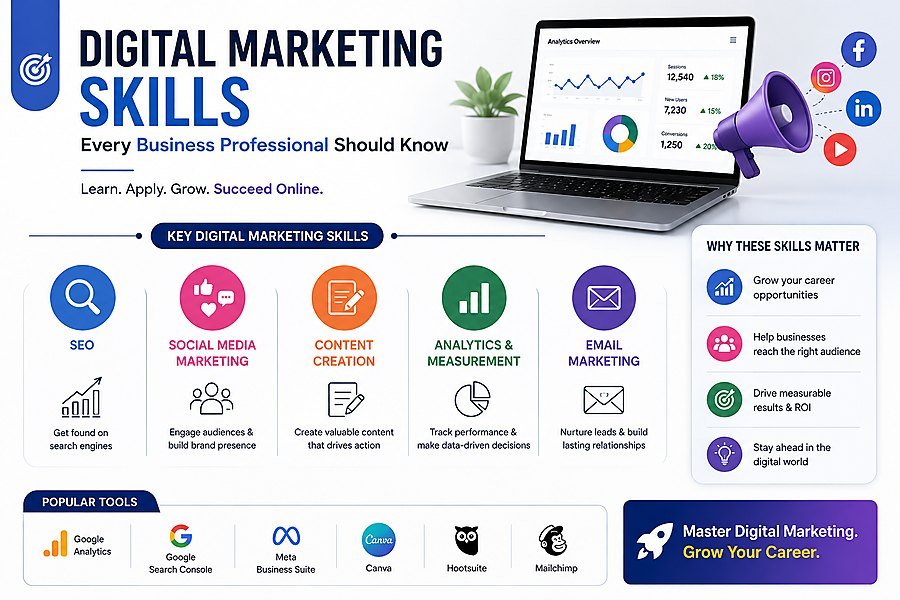
How SEO, Social Media Marketing, Content Creation, and Analytics Drive Modern Business Growth
In today’s digital economy, businesses no longer rely solely on traditional advertising methods to attract customers. Consumers now discover products, services, and brands through search engines, social media platforms, websites, online reviews, and digital content.
As a result, digital marketing has become one of the most important business skills for professionals across industries.
Whether you are an entrepreneur, business owner, marketing executive, sales professional, freelancer, or aspiring manager, understanding digital marketing can help you reach more customers, build stronger brands, and make better business decisions.
Digital marketing is no longer a specialized skill reserved for marketing departments. It has become a core business competency that every professional should understand.
What is Digital Marketing?
Digital marketing refers to promoting products, services, and brands using digital channels and online platforms.
These channels include:
- Search Engines
- Social Media Platforms
- Websites
- Email Marketing
- Content Marketing
- Online Advertising
- Video Platforms
The goal is to connect businesses with their target audiences and drive measurable results.
Why Digital Marketing Matters Today
Modern consumers spend significant time online.
Before making purchasing decisions, they often:
- Search Google
- Read Reviews
- Watch Videos
- Visit Websites
- Check Social Media Profiles
Businesses that establish strong digital visibility gain a competitive advantage.
Digital marketing helps organizations:
- Increase Brand Awareness
- Generate Leads
- Improve Sales
- Build Customer Relationships
- Measure Performance
Skill #1: Search Engine Optimization (SEO)
SEO is the process of improving a website’s visibility on search engines.
When users search for products or services, businesses want their websites to appear among the top results.
SEO involves:
- Keyword Research
- On-Page Optimization
- Technical SEO
- Content Optimization
- Link Building
Why SEO Matters
Benefits include:
- Increased Website Traffic
- Better Brand Visibility
- Higher Lead Generation
- Long-Term Growth
SEO remains one of the most valuable digital marketing skills.
Skill #2: Content Creation
Content is the foundation of digital marketing.
Businesses create content to:
- Educate Customers
- Build Authority
- Improve SEO
- Generate Engagement
Examples include:
- Blogs
- Articles
- Videos
- Infographics
- Social Media Posts
- Case Studies
High-quality content helps businesses attract and retain audiences.
Skill #3: Social Media Marketing
Social media platforms play a major role in modern marketing.
Popular platforms include:
- YouTube
- X (Twitter)
Businesses use social media to:
- Build Communities
- Promote Products
- Engage Customers
- Increase Brand Awareness
Understanding social media strategies is valuable across industries.
Skill #4: Analytics and Data Interpretation
Digital marketing provides measurable results.
Professionals should understand how to analyze:
- Website Traffic
- User Behavior
- Conversion Rates
- Campaign Performance
- Audience Demographics
Data-driven decision-making improves marketing effectiveness.
Common Analytics Tools
- Google Analytics
- Google Search Console
- Social Media Insights
- Power BI
Analytics skills help professionals optimize business performance.
Skill #5: Search Engine Marketing (SEM)
SEM involves paid advertising on search engines.
Businesses use platforms such as:
- Google Ads
- Bing Ads
Benefits include:
- Immediate Visibility
- Targeted Advertising
- Lead Generation
- Measurable Results
Understanding SEM complements SEO efforts.
Skill #6: Email Marketing
Email remains one of the most effective digital communication channels.
Businesses use email marketing for:
- Promotions
- Newsletters
- Customer Retention
- Product Updates
Effective email campaigns help maintain customer relationships.
Skill #7: Personal Branding
Professionals increasingly build their brands online.
Personal branding involves:
- Sharing Expertise
- Creating Content
- Networking Online
- Building Credibility
Platforms such as LinkedIn are powerful tools for professional growth.
Skill #8: Website Fundamentals
Every business professional should understand how websites function.
Important concepts include:
- Landing Pages
- Conversion Optimization
- User Experience
- Mobile Responsiveness
Websites often serve as the central hub of digital marketing efforts.
Skill #9: Video Marketing
Video content continues to dominate online engagement.
Businesses use video for:
- Product Demonstrations
- Tutorials
- Customer Testimonials
- Educational Content
Platforms such as YouTube and social media channels provide significant reach.
Skill #10: Marketing Automation
Businesses increasingly use automation tools to improve efficiency.
Examples include:
- Email Automation
- Lead Nurturing
- Customer Segmentation
- Campaign Scheduling
Automation helps organizations scale marketing activities.
Skill #11: Understanding Customer Behavior
Successful marketing requires understanding customer needs.
Professionals should learn:
- Customer Journey Mapping
- Audience Research
- Buying Behavior Analysis
Better customer understanding leads to more effective campaigns.
Skill #12: Conversion Optimization
Attracting visitors is only part of the process.
Businesses must also convert visitors into:
- Leads
- Customers
- Subscribers
Conversion optimization improves marketing ROI.
Skill #13: Online Reputation Management
Consumers frequently research businesses online.
Professionals should monitor:
- Reviews
- Ratings
- Customer Feedback
Maintaining a positive online reputation strengthens trust.
Skill #14: Basic Graphic Design Awareness
Visual content plays a major role in marketing success.
Understanding basic design principles helps professionals create:
- Social Media Creatives
- Marketing Materials
- Presentations
- Promotional Content
Visual communication improves audience engagement.
Skill #15: Digital Marketing Strategy
Marketing activities should align with business goals.
Professionals should understand:
- Goal Setting
- Audience Targeting
- Campaign Planning
- Performance Measurement
Strategic thinking improves long-term marketing success.
Why Businesses Need Digital Marketing Professionals
Organizations increasingly seek professionals who can:
- Drive Online Growth
- Generate Leads
- Improve Visibility
- Analyze Performance
- Build Brand Awareness
Digital marketing skills create value across departments and industries.
Career Opportunities in Digital Marketing
Learning digital marketing can lead to roles such as:
SEO Specialist
Improve website visibility.
Digital Marketing Executive
Manage campaigns.
Social Media Manager
Build brand presence.
Content Marketer
Create valuable content.
Performance Marketer
Optimize advertising campaigns.
Marketing Analyst
Measure and improve results.
Demand for these roles continues to increase.
Common Mistakes Beginners Make
Ignoring Analytics
Data is essential for improvement.
Focusing Only on Social Media
Marketing requires multiple channels.
Neglecting SEO
Organic visibility drives long-term growth.
Creating Content Without Strategy
Content should support business goals.
Expecting Instant Results
Digital marketing requires consistency.
How Professionals Can Start Learning Digital Marketing
Step 1
Understand SEO basics.
Step 2
Learn content creation.
Step 3
Explore social media marketing.
Step 4
Study analytics tools.
Step 5
Practice with real projects.
Step 6
Analyze campaign performance.
Continuous learning leads to better results.
Future of Digital Marketing
The future of digital marketing will increasingly involve:
- Artificial Intelligence
- Marketing Automation
- Data Analytics
- Personalization
- Video Content
- Voice Search Optimization
Professionals who combine creativity with analytical skills will remain highly valuable.
Frequently Asked Questions
Is digital marketing a good career in 2026?
Yes. Digital marketing continues to be one of the fastest-growing career fields.
Do business professionals need digital marketing skills?
Absolutely. Digital marketing knowledge improves decision-making and business growth.
Is SEO still relevant?
Yes. SEO remains one of the most effective long-term marketing strategies.
Can beginners learn digital marketing?
Yes. Starting with SEO, content creation, and social media marketing is highly recommended.
Conclusion
Digital marketing has become an essential skill for modern business professionals. Understanding SEO, social media marketing, content creation, analytics, email marketing, and digital strategy enables professionals to contribute more effectively to business growth and customer engagement.
As businesses continue expanding their digital presence, professionals who understand how to attract, engage, and convert online audiences will remain highly valuable. Developing digital marketing skills not only improves career opportunities but also provides a deeper understanding of how modern businesses grow in an increasingly connected world.
CadMate India helps students and professionals develop practical digital marketing skills through industry-focused training, real-world projects, and hands-on learning experiences.