
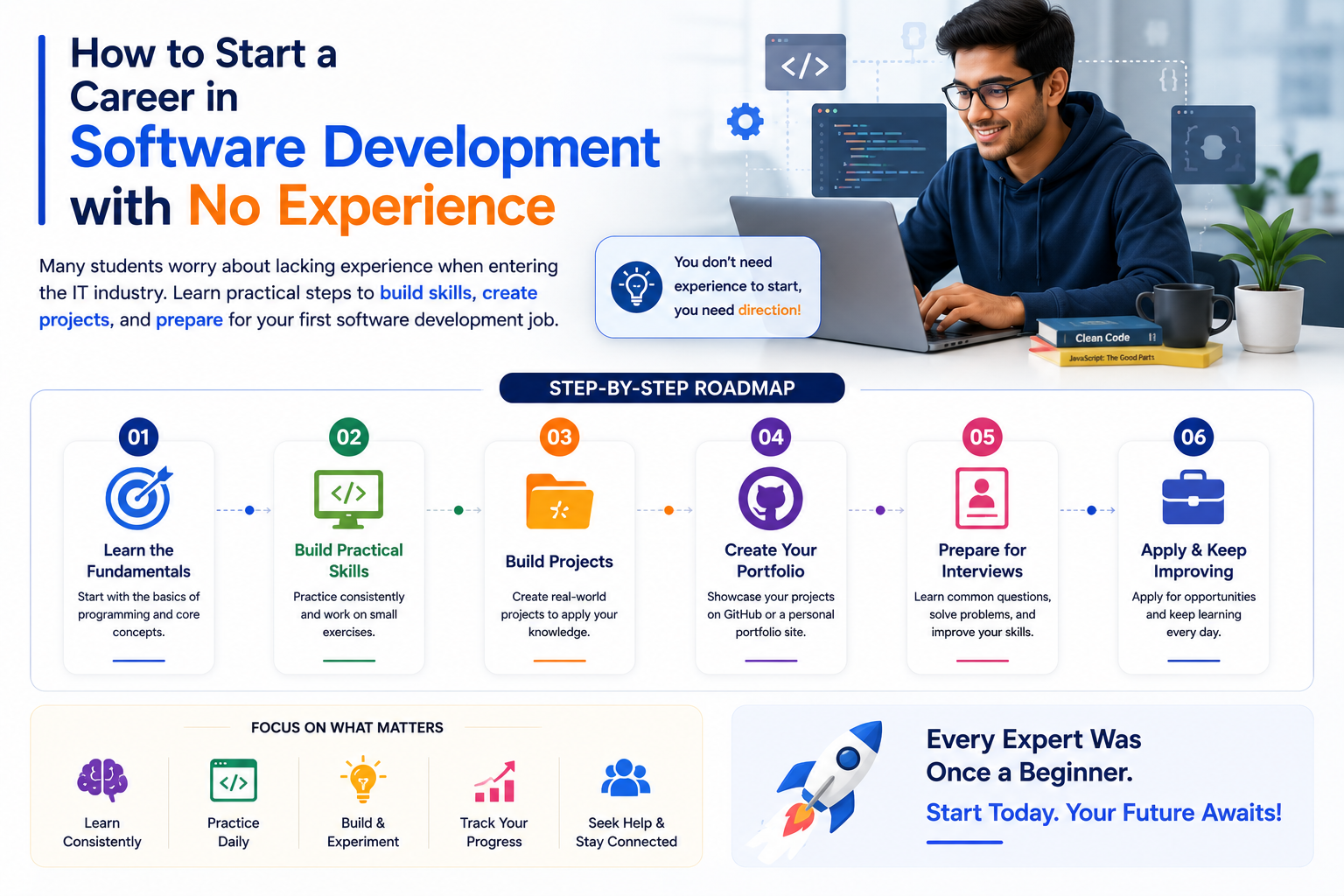
A Practical Guide for Students and Freshers to Build Skills, Create Projects, and Land Their First Software Development Job
One of the biggest concerns among students and fresh graduates is:
“How can I get a software development job if I don’t have any experience?”
It’s a valid concern. Most job descriptions mention experience, projects, technical skills, and practical knowledge. This often makes beginners feel that entering the software industry is difficult.
The reality is that every successful software developer started with no experience.
What separates successful candidates from others is not prior job experience but their willingness to learn, build projects, solve problems, and continuously improve their skills.
Today’s technology industry offers countless opportunities for beginners who are ready to demonstrate their abilities through practical work, portfolios, internships, and personal projects.
If you’re starting from zero, this guide will help you understand the exact steps needed to launch a successful software development career.
Can You Get a Software Development Job Without Experience?
Absolutely.
Most companies hiring freshers understand that candidates may not have professional experience.
Instead, recruiters often evaluate:
- Technical Skills
- Problem-Solving Ability
- Projects
- Portfolio Quality
- Learning Mindset
- Communication Skills
The goal is to prove that you can build software and solve problems effectively.
Step 1: Learn Programming Fundamentals
Before focusing on advanced technologies, students should build a strong foundation.
Learn concepts such as:
- Variables
- Data Types
- Loops
- Functions
- Conditional Statements
- Arrays
- Object-Oriented Programming
Strong fundamentals make future learning easier.
Recommended Languages
For beginners:
- Python
- Java
Both offer excellent learning opportunities and career prospects.
Step 2: Focus on Problem Solving
Software development is about solving problems.
Students should practice:
- Logical Thinking
- Algorithms
- Coding Challenges
- Analytical Reasoning
Popular topics include:
- Arrays
- Strings
- Recursion
- Sorting
- Searching
Problem-solving skills are highly valued during interviews.
Step 3: Learn Data Structures and Algorithms
Data Structures and Algorithms (DSA) help developers write efficient software.
Important topics include:
- Arrays
- Linked Lists
- Stacks
- Queues
- Trees
- Graphs
- Hash Tables
Many companies use DSA questions during technical interviews.
Step 4: Choose a Development Path
The software industry offers multiple career options.
Full Stack Development
Build complete web applications.
Backend Development
Focus on server-side systems.
Frontend Development
Create user interfaces.
Mobile App Development
Build Android and iOS applications.
Data Science
Analyze and interpret data.
Choose one path initially and develop expertise gradually.
Step 5: Build Real Projects
Projects are one of the most effective ways to gain practical experience.
Projects demonstrate:
- Technical Skills
- Problem-Solving Ability
- Creativity
- Project Execution
Examples include:
Beginner Projects
- Calculator
- To-Do Application
- Portfolio Website
Intermediate Projects
- Student Management System
- Expense Tracker
- Blog Platform
Advanced Projects
- E-Commerce Application
- Learning Management System
- AI Chatbot
Projects create experience even without employment history.
Step 6: Create a Strong GitHub Profile
GitHub acts as a public portfolio for developers.
Students should:
- Upload Projects
- Write Documentation
- Maintain Clean Code
- Showcase Contributions
Recruiters often review GitHub profiles to evaluate technical skills.
Step 7: Build a Professional Portfolio Website
A portfolio website helps showcase:
- Projects
- Skills
- Certifications
- Achievements
A portfolio creates a professional online presence and helps recruiters understand your capabilities.
Step 8: Learn Industry Tools
Professional software teams use various tools.
Important tools include:
Version Control
- Git
- GitHub
Development Tools
- VS Code
- IntelliJ IDEA
Collaboration Tools
- Jira
- Trello
Familiarity with industry tools improves job readiness.
Step 9: Understand Databases
Most software applications require data storage.
Students should learn:
- SQL
- Database Design
- Query Writing
Popular databases include:
- MySQL
- PostgreSQL
- MongoDB
Database knowledge is essential for software development.
Step 10: Learn Basic Web Development
Even backend developers benefit from understanding web fundamentals.
Learn:
- HTML
- CSS
- JavaScript
Understanding how applications work improves overall technical competence.
Step 11: Participate in Internships
Internships provide valuable experience.
Benefits include:
- Practical Learning
- Industry Exposure
- Team Collaboration
- Professional Networking
Even short internships can significantly strengthen resumes.
Step 12: Contribute to Open Source Projects
Open-source contributions help students:
- Work on Real Software
- Collaborate with Developers
- Improve Coding Skills
They also demonstrate initiative and practical experience.
Step 13: Improve Communication Skills
Software developers frequently:
- Attend Meetings
- Discuss Requirements
- Present Solutions
- Collaborate with Teams
Strong communication skills improve employability and career growth.
Step 14: Prepare for Technical Interviews
Interview preparation should include:
Coding Practice
Regular problem solving.
DSA Revision
Review fundamental concepts.
Project Discussions
Be prepared to explain your work.
Mock Interviews
Improve confidence and communication.
Preparation significantly improves success rates.
Step 15: Build a LinkedIn Profile
LinkedIn helps students:
- Connect with Recruiters
- Network with Professionals
- Share Projects
- Discover Opportunities
A professional online presence improves visibility.
What Recruiters Look for in Freshers
Employers often value:
✅ Problem-Solving Skills
✅ Project Experience
✅ Learning Ability
✅ Communication Skills
✅ Technical Fundamentals
Recruiters understand that freshers are still learning.
Demonstrating potential is often more important than having years of experience.
Common Mistakes Beginners Make
Waiting Until Graduation
Start building skills early.
Learning Too Many Technologies
Focus on one path first.
Avoiding Projects
Projects create practical experience.
Ignoring GitHub
A strong profile improves credibility.
Comparing Yourself to Experts
Every professional started as a beginner.
Consistency matters more than speed.
Sample Roadmap for Beginners
Months 1–2
Learn programming basics.
Months 3–4
Study DSA and databases.
Months 5–6
Build small projects.
Months 7–8
Learn development frameworks.
Months 9–10
Create portfolio and GitHub profile.
Months 11–12
Prepare for internships and interviews.
This structured approach helps students progress steadily.
Why Experience Isn’t Everything
Many students believe they need experience before applying for jobs.
In reality, projects, internships, open-source contributions, and practical learning often provide enough evidence of capability.
Employers want candidates who can:
- Learn Quickly
- Solve Problems
- Adapt to Technology
- Work Effectively
These qualities can be demonstrated without formal work experience.
Future of Software Development Careers
The software industry continues to expand through:
- Artificial Intelligence
- Cloud Computing
- Cybersecurity
- Automation
- Digital Transformation
Demand for skilled developers remains strong.
Students who invest in practical learning and project development position themselves for long-term success.
Frequently Asked Questions
Can I become a software developer without a degree?
Yes. Skills, projects, and practical experience often matter more than formal qualifications.
Do projects count as experience?
Absolutely. Projects demonstrate technical ability and problem-solving skills.
Is GitHub important for freshers?
Yes. It showcases your work and technical growth.
How long does it take to become job-ready?
It varies, but consistent learning and project development can make students job-ready within several months.
Conclusion
Starting a career in software development without experience is entirely possible. The key is to focus on learning programming fundamentals, building projects, solving problems, creating a strong portfolio, and continuously improving your skills. Practical experience gained through projects, internships, and open-source contributions often matters more than formal job experience when applying for entry-level positions.
Students who stay consistent, embrace challenges, and focus on creating real solutions can successfully launch rewarding careers in software development. Every experienced developer once started with no experience—the important step is simply getting started.
CadMate India helps students build job-ready software development skills through practical training, real-world projects, portfolio development, and industry-focused learning designed to prepare them for successful technology careers.