
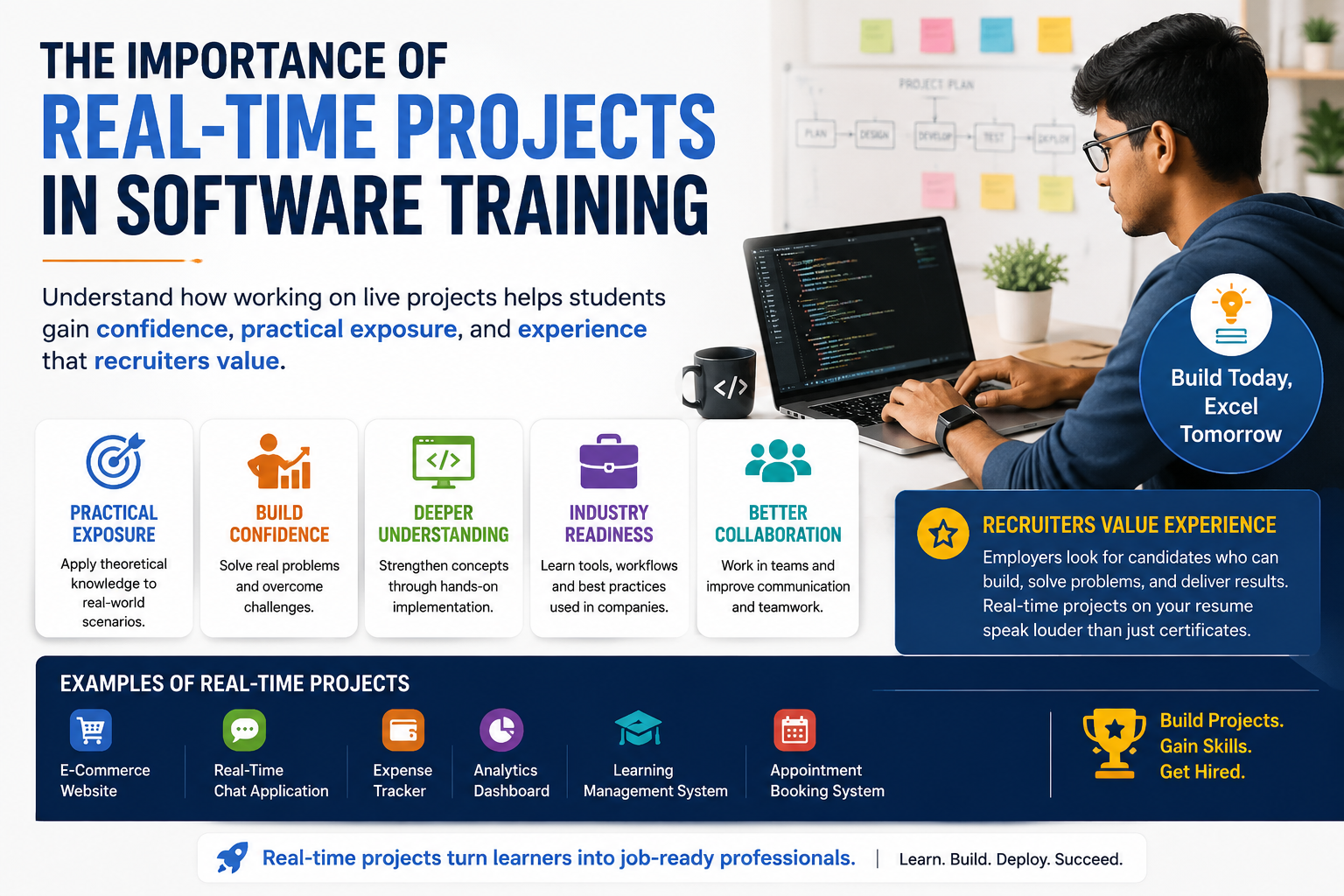
Why Working on Live Projects Helps Students Become Industry-Ready Faster
One of the biggest challenges faced by students entering the software industry is the gap between academic learning and real-world job requirements.
Many students learn programming languages, complete assignments, and earn certificates, yet struggle when asked to build real applications or solve practical business problems.
This is where real-time projects play a crucial role.
In today’s competitive technology industry, employers increasingly look for candidates who can demonstrate practical experience, problem-solving abilities, and project execution skills rather than just theoretical knowledge.
Working on live projects gives students exposure to real development environments, industry workflows, team collaboration, and practical challenges that cannot be fully replicated through classroom learning alone.
As a result, students gain confidence, technical expertise, and industry readiness that significantly improve their career opportunities.
What Are Real-Time Projects?
Real-time projects are practical assignments based on real-world business requirements.
Unlike academic exercises, these projects involve:
- Actual Use Cases
- Industry Scenarios
- Client Requirements
- Team Collaboration
- Project Deadlines
- Problem Solving
Examples include:
- E-Commerce Websites
- Learning Management Systems
- CRM Applications
- Data Analytics Dashboards
- AI Chatbots
- Mobile Applications
These projects help students experience how software is developed in professional environments.
Why Traditional Learning Alone Is Not Enough
Most academic programs focus on:
- Theory
- Exams
- Assignments
- Classroom Exercises
While these elements build foundational knowledge, they often lack:
- Real Business Context
- Team Collaboration
- Deployment Experience
- Client Expectations
- Practical Troubleshooting
Students may know programming concepts but struggle when applying them in real-world situations.
Real-Time Projects Bridge the Industry Gap
One of the biggest benefits of live projects is that they connect learning with practical implementation.
Students learn how to:
- Convert Requirements into Solutions
- Build Complete Applications
- Work with Teams
- Deliver Functional Products
This practical exposure prepares them for workplace environments.
Builds Real-World Problem-Solving Skills
Software development is not just about writing code.
Developers regularly encounter challenges such as:
- Debugging Errors
- Performance Issues
- Database Problems
- API Failures
- Deployment Challenges
Real-time projects expose students to these situations.
By solving actual problems, students develop analytical thinking and troubleshooting abilities.
Improves Technical Confidence
Many students feel nervous during interviews because they have limited practical experience.
Working on live projects helps students:
- Build Applications Independently
- Make Technical Decisions
- Solve Development Challenges
- Present Solutions
Confidence grows naturally through experience.
Understanding Complete Software Development Lifecycle
Real-time projects introduce students to every phase of development.
Requirement Analysis
Understanding user needs.
Planning
Designing project architecture.
Development
Writing and integrating code.
Testing
Ensuring software quality.
Deployment
Making applications available to users.
Maintenance
Improving and updating systems.
Understanding this lifecycle is valuable for software engineering careers.
Learning Industry Tools and Technologies
Professional software teams use tools such as:
- Git & GitHub
- Jira
- Docker
- Cloud Platforms
- CI/CD Pipelines
Real-time projects help students become familiar with industry-standard workflows.
Enhances Team Collaboration Skills
Modern software development is highly collaborative.
Students working on live projects learn:
- Communication
- Team Coordination
- Task Management
- Code Reviews
- Project Planning
These professional skills are highly valued by employers.
Creates Strong Project Portfolios
A strong portfolio helps students showcase their abilities.
Projects demonstrate:
- Technical Skills
- Problem-Solving Ability
- Creativity
- Project Execution
Recruiters often prefer candidates who can show completed projects rather than only certifications.
Improves Interview Performance
Interviewers frequently ask:
- What projects have you worked on?
- What challenges did you face?
- How did you solve them?
Students with real project experience can confidently answer these questions using actual examples.
This significantly improves interview performance.
Helps Students Understand Client Requirements
In professional environments, developers work to solve customer problems.
Real-time projects teach students how to:
- Gather Requirements
- Clarify Expectations
- Understand User Needs
- Deliver Solutions
This customer-focused mindset is essential for career growth.
Provides Exposure to Industry Workflows
Students learn how professional teams:
- Plan Projects
- Track Progress
- Manage Tasks
- Collaborate Effectively
This exposure reduces the learning curve when joining companies.
Real-Time Projects and Placement Success
Students with project experience often:
- Build Better Resumes
- Develop Stronger Portfolios
- Gain Practical Confidence
- Perform Better in Interviews
These advantages improve placement opportunities.
The Role of Live Projects in Full Stack Development
Full Stack Development requires understanding:
- Frontend Development
- Backend Development
- Databases
- APIs
- Deployment
Live projects help students connect these technologies into complete applications.
Real-Time Projects in Data Analytics
Analytics students benefit from projects involving:
- Data Cleaning
- Visualization
- Dashboard Creation
- Business Reporting
These experiences improve practical data analysis skills.
Real-Time Projects in Artificial Intelligence
AI students gain experience by:
- Training Models
- Building AI Applications
- Deploying AI Solutions
- Solving Real Business Problems
Practical implementation improves understanding significantly.
Why Employers Value Project Experience
Recruiters look for candidates who can:
✅ Apply Knowledge
✅ Solve Problems
✅ Work in Teams
✅ Build Applications
✅ Learn Quickly
Projects demonstrate these qualities effectively.
Common Mistakes Students Make
Focusing Only on Theory
Practical experience is equally important.
Avoiding Team Projects
Collaboration skills matter.
Building Only Tutorial Projects
Original projects create stronger portfolios.
Ignoring Deployment
Applications should be accessible to users.
Waiting Until Final Year
Practical experience should start early.
How Students Can Start Working on Real-Time Projects
Build Small Projects
Start simple.
Collaborate with Peers
Learn teamwork.
Participate in Internships
Gain industry exposure.
Contribute to Open Source
Work on real-world applications.
Create Portfolio Projects
Showcase skills publicly.
Consistent practice leads to growth.
Future of Software Training
The future of IT education is becoming increasingly project-driven.
Employers want candidates who can:
- Build Solutions
- Adapt Quickly
- Solve Problems
- Work in Teams
Real-time projects provide exactly these experiences.
Frequently Asked Questions
Are live projects important for placements?
Yes. They significantly improve practical skills and interview performance.
Do projects matter more than certificates?
Projects often provide stronger evidence of technical capability.
Can beginners work on real-time projects?
Absolutely. Starting with small projects is highly recommended.
Why do recruiters ask about projects?
Projects demonstrate real-world problem-solving and implementation skills.
Conclusion
Real-time projects play a critical role in software training because they help students move beyond theory and gain practical experience. By working on live applications, solving real problems, collaborating with teams, and understanding industry workflows, students develop the confidence and technical abilities that employers value most.
The combination of strong fundamentals and practical project experience creates industry-ready professionals who can contribute effectively from the beginning of their careers. For students aiming to succeed in software development, data analytics, artificial intelligence, or full stack development, real-time projects are one of the most powerful learning tools available.
CadMate India focuses on practical, project-based learning that helps students gain real-world experience and build the skills required for successful technology careers.