
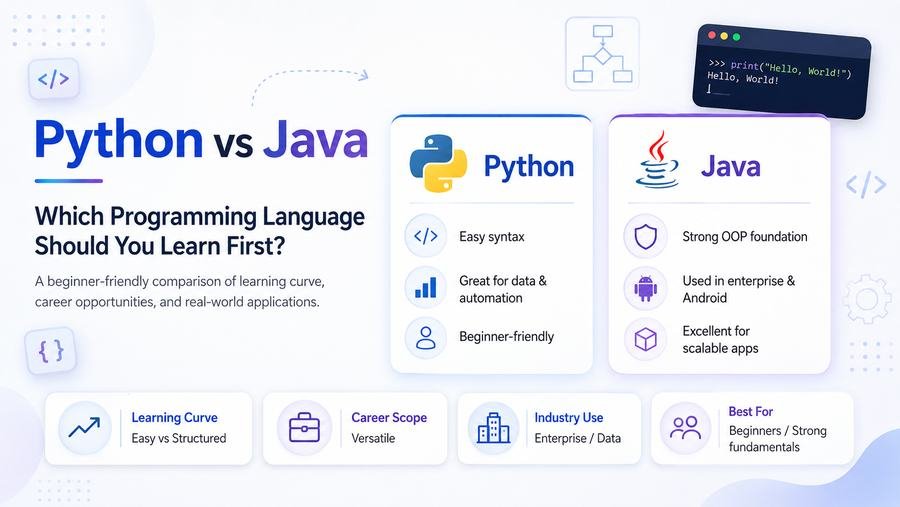
A Beginner-Friendly Guide to Choosing the Right Programming Language for Your Career
One of the most common questions students ask when starting their programming journey is:
“Should I learn Python or Java first?”
Both Python and Java are among the most popular programming languages in the world. They are used by leading technology companies, startups, financial institutions, healthcare organizations, and software development firms.
Choosing the right first language can influence how easily you learn programming concepts and the types of career opportunities available to you.
The good news is that there is no wrong choice.
Both Python and Java can lead to successful careers in software development, data science, artificial intelligence, cloud computing, and enterprise technology.
The key is understanding their differences, strengths, learning curves, and career applications.
Why Choosing Your First Programming Language Matters
Your first programming language helps you:
- Understand Programming Logic
- Learn Problem Solving
- Build Projects
- Develop Confidence
- Create a Technical Foundation
Once you learn one language properly, learning additional languages becomes much easier.
Therefore, the goal is not simply choosing a language but choosing a strong starting point.
What is Python?
Python is a high-level programming language known for its simplicity and readability.
Created by Guido van Rossum, Python has become one of the most widely used languages globally.
Python is used in:
- Artificial Intelligence
- Machine Learning
- Data Science
- Automation
- Web Development
- Cybersecurity
- Data Analytics
Python’s clean syntax makes it beginner-friendly.
Example of Python Code
print("Hello World")
Simple and easy to understand.
What is Java?
Java is an object-oriented programming language developed by Sun Microsystems.
Java has been one of the most trusted enterprise programming languages for decades.
Java is widely used in:
- Enterprise Applications
- Banking Systems
- E-Commerce Platforms
- Android Development
- Cloud Applications
- Large-Scale Software Systems
Example of Java Code
public class Main {
    public static void main(String[] args) {
        System.out.println("Hello World");
    }
}
Java requires more structure but teaches strong software engineering principles.
Learning Curve: Python vs Java
Python
Advantages:
✔ Easy Syntax
✔ Faster Learning
✔ Beginner Friendly
✔ Less Code
Python allows students to focus on programming concepts rather than language complexity.
Java
Advantages:
✔ Strong Programming Foundations
✔ Object-Oriented Thinking
✔ Better Understanding of Software Engineering
Java requires more effort initially but often develops stronger technical discipline.
Winner for Beginners:
🏆 Python
Python generally has a smoother learning curve for absolute beginners.
Syntax Comparison
Python was designed for simplicity.
Java was designed for structure and scalability.
Python Example:
age = 20
Java Example:
int age = 20;
Python requires fewer rules and less boilerplate code.
Java introduces concepts such as:
- Classes
- Objects
- Methods
- Access Modifiers
earlier in the learning process.
Python for Artificial Intelligence and Data Science
Python dominates fields such as:
- Artificial Intelligence
- Machine Learning
- Data Science
- Deep Learning
Popular Python Libraries:
- NumPy
- Pandas
- Matplotlib
- TensorFlow
- PyTorch
- Scikit-Learn
Students interested in AI often start with Python.
Java for Enterprise Development
Java powers many large-scale systems.
Industries using Java include:
- Banking
- Insurance
- Telecommunications
- Healthcare
- Government
Popular Java Technologies:
- Spring Boot
- Hibernate
- Maven
- Microservices
Java remains a top choice for enterprise software development.
Job Opportunities in Python
Popular roles include:
Python Developer
Build applications and automation tools.
Data Analyst
Analyze business data.
Data Scientist
Create predictive models.
Machine Learning Engineer
Develop AI systems.
Automation Engineer
Automate business processes.
Demand for Python continues to grow worldwide.
Job Opportunities in Java
Popular roles include:
Java Developer
Build enterprise applications.
Backend Engineer
Develop APIs and services.
Software Engineer
Create scalable systems.
Android Developer
Develop mobile applications.
Full Stack Developer
Work on complete web applications.
Java remains highly demanded in enterprise environments.
Which Language Pays More?
Salary depends on:
- Skills
- Experience
- Location
- Industry
Both Python and Java professionals enjoy excellent career opportunities.
Rather than salary, students should focus on learning strong fundamentals.
Performance Comparison
Java
Generally faster because it is compiled.
Used in performance-intensive enterprise systems.
Python
Slightly slower but highly productive.
Ideal for rapid development and AI applications.
For beginners, productivity matters more than performance.
Object-Oriented Programming
Java heavily emphasizes:
- Classes
- Objects
- Encapsulation
- Inheritance
- Polymorphism
Students often develop stronger OOP understanding with Java.
Python also supports OOP but introduces it more gradually.
Industry Adoption
Companies Using Python
- Netflix
- Spotify
- Dropbox
Companies Using Java
- Amazon
- Uber
- Many Banking Institutions
Both languages have strong industry support.
Which Language is Better for Placements?
Both are excellent choices.
However:
Python
Strong for:
- AI
- Data Science
- Analytics
Java
Strong for:
- Software Engineering
- Backend Development
- Enterprise Jobs
Students should align learning with career goals.
Can You Learn Both?
Absolutely.
Many successful developers learn:
- One language deeply.
- A second language later.
Learning programming concepts is more important than learning multiple languages immediately.
Common Mistakes Students Make
Learning Multiple Languages Simultaneously
Creates confusion.
Ignoring Problem Solving
DSA remains essential.
Focusing Only on Syntax
Concepts matter more.
Avoiding Projects
Projects improve understanding.
Chasing Trends
Strong foundations create long-term success.
Recommended Learning Path
If You Want AI or Data Science
Learn:
- Python
- Data Structures
- Data Analytics
- Machine Learning
If You Want Software Engineering
Learn:
- Java
- Data Structures & Algorithms
- Database Management
- Backend Development
If Unsure
Start with Python and later learn Java.
This approach works well for many students.
Skills That Matter More Than Language Choice
Employers care about:
- Problem Solving
- Projects
- System Design
- Databases
- Git & GitHub
- Communication Skills
Programming language choice is only one part of career success.
Frequently Asked Questions
Is Python easier than Java?
Yes. Python generally has a simpler syntax and shorter learning curve.
Is Java still relevant in 2026?
Absolutely. Java remains one of the most widely used enterprise programming languages.
Which language is best for AI?
Python dominates AI and Machine Learning.
Which language is best for software engineering?
Java remains one of the strongest choices for enterprise software engineering.
Conclusion
Both Python and Java are excellent programming languages that offer strong career opportunities. Python is easier for beginners and dominates AI, machine learning, data science, and automation. Java provides a deeper understanding of software engineering concepts and continues to power large-scale enterprise applications worldwide.
The best choice depends on your career goals. If you are interested in AI, analytics, or automation, Python is often the ideal starting point. If you want to build enterprise applications, backend systems, or develop strong object-oriented programming skills, Java is an excellent choice.
Ultimately, success depends less on the language you choose and more on your ability to solve problems, build projects, and continuously improve your skills.
CadMate India helps students learn industry-relevant programming languages through practical training, real-world projects, and career-focused technical education.